Choose the park days before choosing the bed
Karijini is a large park, and a booking near one area does not put every gorge within a short walk. Mark the places you actually hope to visit, then compare accommodation and campground locations against those journeys. A cheaper bed far away can mean substantial daily driving.
Reserve your stay and check what it supplies. Drinking water, meals, fuel and laundry should not be assumed. If camping, read the individual site's facilities and booking conditions. Arriving prepared allows the following morning to begin with the park rather than a long errand.
Group Dales and Weano into separate outings
Use the park map to distinguish the Dales area from the Weano side before selecting a campground or other accommodation. A first full day around one area and a second around the other is more coherent than repeatedly crossing the park to alternate individual gorges. Hamersley Gorge should be assessed as another distinct journey, not an automatic extra at the end of a tired afternoon.
For a three-night visit, use arrival to settle in and confirm advice, the first complete day for a suitable Dales-area route, and the second for selected Weano-area viewpoints or walks. The exact routes must follow current access and the group's ability. On departure morning, keep only a short nearby stop if the onward drive permits it.
If you have two nights, choose one area for the full day and leave the other optional. If your chosen accommodation sits far from that area, reconsider the base before booking. It is usually better to adjust the bed or narrow the walking list than to accept repeated long drives simply because all the gorge names sound equally important.
Separate lookouts from gorge descents
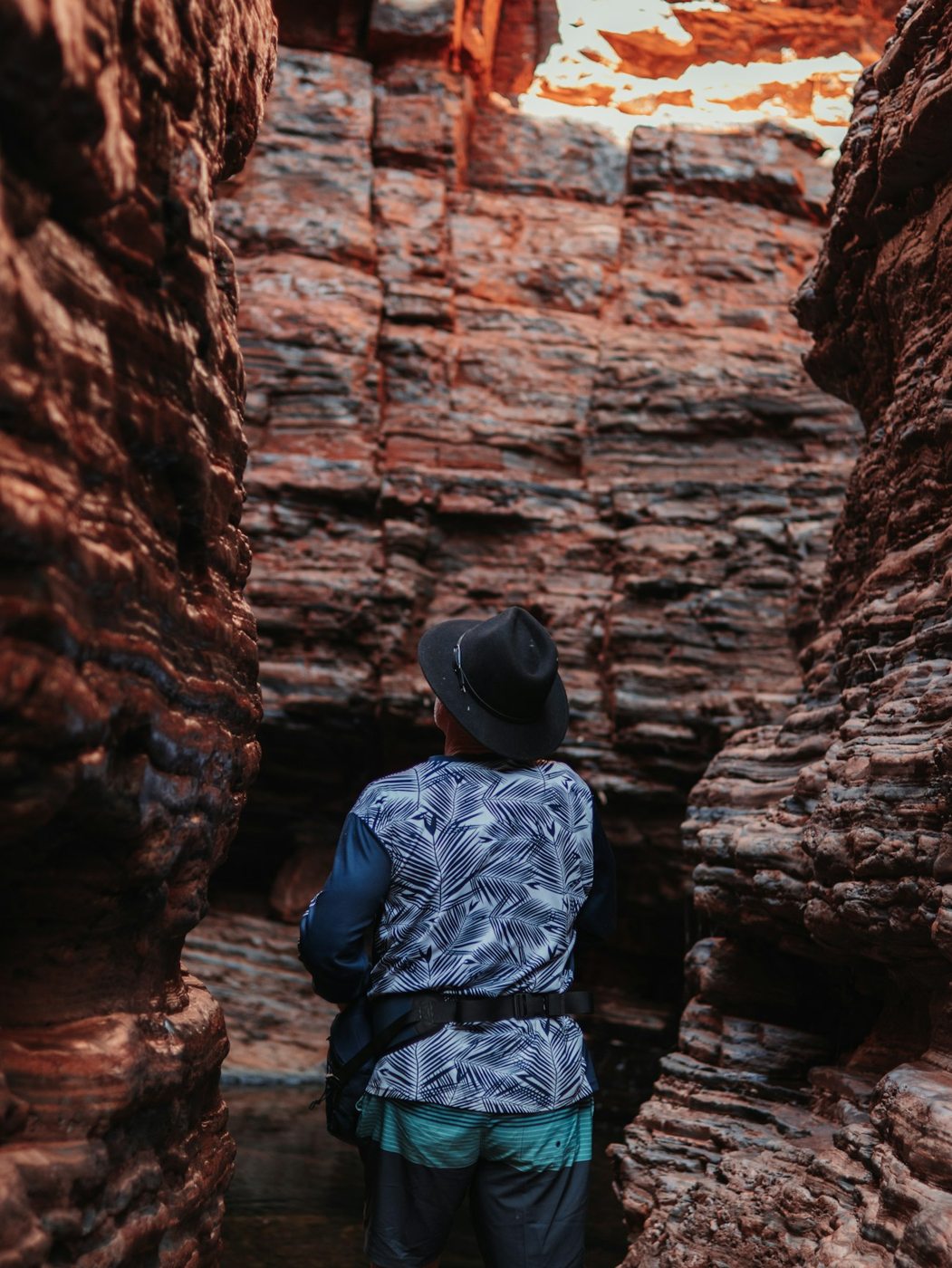
A lookout visit and a gorge walk are different levels of commitment. Read the official description for each trail, including its grade and any current restrictions. Narrow passages, uneven surfaces and water can change the experience; a short distance does not necessarily mean an easy route.
Select a walk that suits the least confident person in the group. If people split up, agree on a clear meeting arrangement and avoid leaving someone waiting without shade, water or an expected return time. There is no need to descend into every gorge to appreciate the landscape.
Use the visitor centre and current notices
The park visitor centre is a useful source of current advice. Check opening arrangements and obtain information before committing to a route. Conditions can change after rain, and an old itinerary or photograph is not evidence that a particular section is currently open.
Keep a simpler alternative in the same part of the park. If a demanding walk is closed or unsuitable, a nearby lookout can preserve the day without triggering a long drive to the opposite side. The decision to turn around should be easy to make, not something that threatens the entire schedule.
Allow time between major walks
Plan the more demanding outing for a fresh morning and keep the afternoon lighter. Wet footwear, heat and repeated climbing can accumulate fatigue. Returning to camp with time to organise food and equipment makes the next day more enjoyable.
A two-night stay gives one complete day; three nights offer more room to separate park areas. If you have travelled a long distance to get here, count the arrival and departure drives honestly. Neither is a reliable opportunity for squeezing in an additional substantial gorge walk.
Check vehicle access before setting out
Read current road advice and confirm that every road you plan to use is permitted for your rental vehicle. Do not interpret a navigation shortcut as an approved route. Save maps and essential booking details offline, and organise fuel before it becomes urgent.
Karijini rewards a prepared, selective visit. A few well-matched walks with time to look around are more satisfying than an overloaded list. Leave enough flexibility that weather, a closure or a tired traveller can change the plan without creating a difficult onward journey.